Source Anti Slip Rubber Foot Pad for Industrial, Vehicle, and Household
Compare 30 anti slip rubber foot pad options from verified Chinese manufacturers. Buyers can evaluate customization, material types like natural rubber, and performance features such as anti-corrosion and high voltage resistance for diverse industrial and household applications; compare the available evidence and request quotations based on your requirements.
Key considerations
Products List




Comprehensive Sourcing Guide
Anti Slip Rubber Foot Pad Sourcing Guide
Procurement professionals must first distinguish between generic rubber slabs and specialized foot pads designed for anti-vibration and anti-slip performance. The observed market data indicates that products often feature natural rubber or pad materials with specific hardness ranges from 30 to 90 Shore A, depending on the specific industrial requirement. Buyers should verify that the selected unit offers the necessary elasticity and impact resistance to function effectively as a cabinet or vehicle component.
The sourcing landscape reveals a wide variance in customization capabilities, with many suppliers offering models like GF-593 or SS059 that adhere to custom drawings. While some listings suggest standard dimensions, the majority of viable options allow for tailored sizes and shapes to fit unique machinery or furniture bases. It is critical to confirm whether the supplier provides the specific anti-corrosion or high-voltage insulation properties required for your specific operational environment before finalizing the order.
Product Scope and Observed Listing Signals
Buyers should analyze the observed listing signals to understand the breadth of available configurations, noting that products often appear with varying model numbers such as GF-434 or GF-01018. These identifiers often correspond to specific material compositions, such as pure gum rubber sheets or fabric blends, which directly influence the final product's durability and slip resistance. Understanding these distinctions helps in filtering out generic inventory that may not meet the rigorous demands of industrial or agricultural applications.
The market data highlights that packaging and shipping methods vary significantly, with options ranging from standard cartons to custom requests upon specific demand. Some suppliers list a minimum order quantity of 10,000 pieces, while others may accommodate smaller batches, requiring careful negotiation to align with your inventory strategy. It is essential to verify if the listed price range reflects the specific customization level, as bespoke molding and cutting services often incur different commercial terms than standard stock items.
Technical Specifications to Verify
Technical verification must begin with the raw material composition, ensuring the product utilizes natural rubber or specific pad materials that guarantee long working life and heat resistance. Buyers should explicitly confirm the hardness rating, as the observed range of 30 to 90 Shore A allows for significant variation in performance characteristics. Selecting the correct hardness is vital for applications requiring either high impact absorption or rigid support, and this parameter should be validated against your engineering drawings.
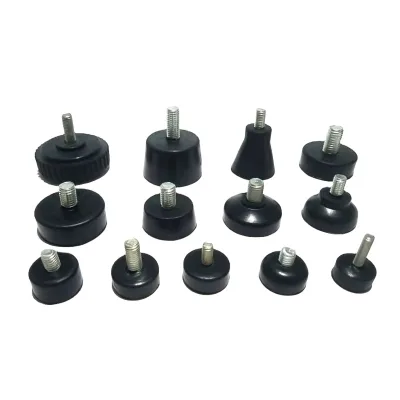
The manufacturing process and connection methods are equally critical, with casting and welding techniques often cited in product descriptions. Buyers must ensure the production method aligns with the required structural integrity, particularly for high-voltage or anti-corrosion applications where material consistency is paramount. Additionally, the head code and shape, often described as round or square antiskid, must be verified to ensure the foot pad provides the necessary friction and stability for the intended equipment.
Compliance and Safety Documentation
Compliance verification requires confirming that the supplier holds valid ISO and CE certifications, which are frequently listed as standard credentials for these industrial rubber components. These certifications serve as a baseline indicator that the manufacturing facility adheres to recognized quality management systems and safety standards, reducing the risk of sourcing non-compliant materials. Buyers should request current certification documents to ensure they remain valid and cover the specific product models being procured.
Safety documentation must also address the specific performance claims, such as corrosion resistance, wear resistance, and insulating properties, which are essential for protecting equipment and personnel. While some listings mention high-voltage capabilities, these claims must be backed by test results or material data sheets rather than marketing assertions. Procurement teams should ensure that the product meets the specific safety standards required for its application, whether it is used in a vehicle, industrial setting, or household environment.
Cost Drivers and Commercial Terms
Cost drivers in this category are heavily influenced by the level of customization, as custom drawings and specific size requirements often necessitate unique molding and cutting processes. The observed minimum order quantities, which can range from single units to 100,000 pieces, significantly impact the unit price and overall procurement budget. Buyers should negotiate based on volume tiers, understanding that larger orders may unlock better pricing but require higher upfront capital commitment.
Commercial terms regarding shipping and packaging must be clearly defined, as options like sea or air freight and carton-based packing affect the total landed cost. Some suppliers offer shipping by cartons, while others may require specific packing requests that could add to the logistical complexity and expense. It is advisable to clarify whether the quoted price includes all packaging materials and shipping costs to avoid unexpected charges that could erode the projected savings from the procurement.
Supplier Qualification and Quality Control
Supplier qualification should focus on their ability to meet the "as per drawing" standard, ensuring they possess the technical capacity to replicate exact specifications without deviation. Buyers must assess the supplier's track record for maintaining consistency in material properties, such as the use of natural rubber or specific pad compositions, across different production batches. A reliable supplier will demonstrate a robust quality control process that verifies hardness, elasticity, and anti-slip performance before shipment.
Quality control protocols must also include checks for the condition of the product, ensuring all items are new and free from defects like cracks or uneven surfaces. The supplier should provide evidence of their processing services, such as molding and cutting, to confirm that the final product matches the requested dimensions and features. Establishing a clear communication channel for quality feedback is essential to address any discrepancies immediately and maintain the integrity of the supply chain.
Long-Term Procurement Checks
Long-term procurement strategies should prioritize suppliers who offer consistent customization and reliable lead times for repeat orders. Buyers need to monitor the stability of the raw material supply, as fluctuations in the availability of natural rubber or pad materials could impact production schedules and product quality. Establishing a partnership with a supplier who can adapt to changing requirements ensures a steady flow of high-quality anti-slip foot pads for ongoing operations.
Regular performance reviews are necessary to validate that the products continue to meet the original specifications for wear resistance, heat resistance, and anti-vibration capabilities. Procurement teams should track the actual performance of the foot pads in the field to identify any early signs of degradation or failure. By maintaining a proactive approach to supplier management and product evaluation, organizations can mitigate risks and ensure the continued reliability of their equipment and infrastructure.
FAQs
What materials are used for anti slip rubber foot pads?
These pads are made from natural rubber and pad materials. They feature pure gum rubber sheet and fabric for durability. The product offers high elasticity and anti-corrosion properties suitable for industrial and household applications.
Can I request custom sizes for these rubber foot pads?
Yes, customization is available for size and specifications. The product model supports custom dimensions based on drawings. Buyers can specify requirements for hardness ranging from 30 to 90 Shore A depending on their specific needs.
Which certifications do these rubber foot pads hold?
The products hold ISO and CE certifications. These standards ensure quality and safety for industrial use. The manufacturing process follows specific drawings to maintain consistency across all customized orders.
How are anti slip rubber foot pads packaged for shipping?
Packing is done in cartons or upon specific request. Some items are shipped with cartons while others use standard carton cases. The packaging ensures protection during transit for various industrial applications.
What is the minimum order quantity for these pads?
The minimum order quantity can be as low as one unit. Some specific models require a minimum of 10,000 pieces. Buyers should check the specific product model to confirm the exact MOQ requirements.
Can these pads be used in high voltage environments?
Yes, they are designed with high voltage functionality. The rubber material provides excellent insulation and impact resistance. This makes them suitable for electronic and industrial applications requiring safety features.
What is the origin of these anti slip rubber foot pads?
The products originate from China. They are manufactured using casting and molding processes. The origin ensures access to competitive pricing and a wide range of customization options for buyers.